Patterns, not labels
You are more than any one element. The framework helps name tendencies without turning them into fixed identity.
A clear, practical guide to Wood, Fire, Earth, Metal, and Water as five natural modes of attention that shape how you think, relate, decide, and grow.
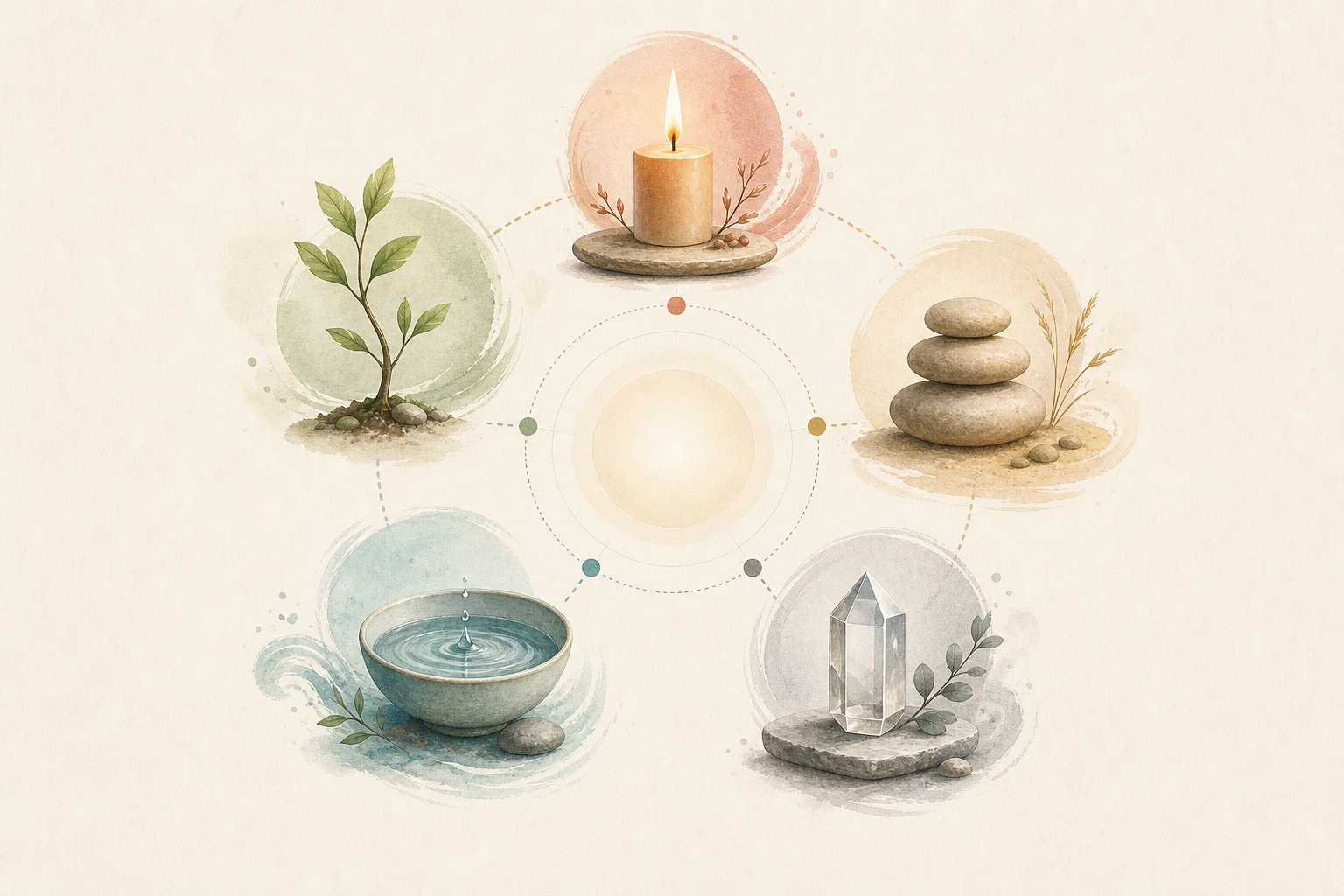
The Five Elements are most useful when they stay grounded: not as destiny, but as a language for noticing patterns in attention, stress, motivation, and growth.
You are more than any one element. The framework helps name tendencies without turning them into fixed identity.
Your balance can shift across seasons, roles, relationships, and life experiences.
Use your element to understand strengths, blind spots, and the next small step toward balance.
The model looks at mind, emotion, behavior, and how you relate to others.
Apply it in work, relationships, decisions, and self-development without treating it as a prediction.
Each element names a different way of meeting life: growing, connecting, stabilizing, refining, or reflecting. Most people recognize one pattern first, then discover the others through balance.
Stability and care
Earth describes the part of personality that steadies, supports, gathers people, and turns abstract needs into practical care.
Clarity and refinement
Metal describes the part of personality that edits, clarifies, protects standards, and notices what is essential.
Depth and reflection
Water describes the part of personality that observes beneath the surface, conserves energy, and adapts to changing conditions.
The framework is dynamic. Elements can support each other, regulate each other, and show where a person may need more balance in daily life.
One pattern gives energy to the next, moving from vision to expression, care, structure, reflection, and renewed growth.
Wood → Fire → Earth → Metal → Water
Vision finds expression.
Energy becomes care.
Support becomes structure.
Clarity deepens insight.
Reflection renews growth.
One pattern can moderate another when a strength becomes too intense, helping the whole system stay flexible.
Balance, not control
Direction can keep care from becoming overextended.
Stability can keep reflection from drifting too far inward.
Depth can help enthusiasm become more measured.
Expression can soften standards that have become too rigid.
Structure can help growth become focused and sustainable.
Treat these cycles as practical metaphors for balance. They are not predictions, diagnoses, or fixed rules about who you are.
The best use of the Five Elements personality framework is practical: notice your pattern, respect its strengths, and keep widening your range.
Notice what you naturally protect, pursue, avoid, or overuse when life gets busy.
Recognize why some people energize you while others challenge your pace, boundaries, or way of caring.
Understand whether you tend to lead with vision, momentum, support, standards, or deep analysis.
Build practices that support your natural strengths and soften the places where you get stuck.
Create balanced teams by noticing where different strengths complement each other.
A grounded read of the framework keeps it useful, flexible, and human.
No. This site uses the Five Elements as a self-reflection and educational framework. It does not make predictions, diagnose people, or claim that personality is fixed by birth data.
Your core tendencies may feel familiar for a long period, but people can grow, adapt, and express different elements in different contexts. The framework is meant to support reflection, not lock you into a label.
Each of the five elements can express through a Yang pattern or a Yin pattern. Yang tends to be more outward and initiating, while Yin tends to be more inward and responsive.
The simplest starting point is to take the free Five Elements personality test, then read the element and Yin-Yang explanations to see what feels accurate and useful.
Go from the five core patterns to your type result and the Yin-Yang layer that shapes expression.
Take the free 20-question Five Elements personality test and use your result as a reflection point, not a fixed label.